Showing posts with label funny books. Show all posts

Sunday, 20 May 2012

S is for (Andreas) Steinhöfel...

... a multi-award winning German author and translator. His books Dirk und Ich (My Brother and I) and The Centre of My World have also been translated into English, but the most widely available is The Pasta Detectives, published in 2010 by The Chicken House and translated from the German by Chantal Wright, one of my MA colleagues. It also features new illustrations by Steve Wells. The US edition (2011) is published under the title The Spaghetti Detectives and seems not to be illustrated.

The Pasta Detectives, pub. The Chicken House, 2010The Spaghetti Detectives, US edition, Chicken House, 2011


It's the story of Rico, aged 11 and a "child proddity"
-  "That's a bit like being a child prodigy, but also like the opposite. I think an awful lot, but I need a lot of time to figure things out." - 
who lives in Berlin with his mum. He has trouble telling the difference between left and right, and gets all kinds of things mixed up, yet he also notices a lot that other people don't see. He becomes friends with Oscar, who is a child prodigy but also prone to anxiety. Together they manage to solve the mystery of what exactly is going on in Rico's building, the "Aldi Kidnapper" or "Mr 2000", and the significance of the "deeper shadows".

This is another book with lots of wordplay as Rico often misunderstands what he hears. He also has difficulty with spelling, so when his teacher encourages him to write a diary the results are interesting, to say the least. As well as managing these challenges adroitly, the translation really catches Rico's voice and his view of the world - his head swirls with ideas like the balls bouncing around in a lottery machine. Some of Rico's ideas are very funny, while others are genuinely thought-provoking. You can see why it was shortlisted for the 2011 Marsh Award for Children's Literature in Translation. The book also won the 2011 NASEN Inclusive Children's Book Award and, with a first person narrator who seems to be somewhere on the austistic spectrum, it has invited comparisons with Mark Haddon's Curious Incident of the Dog in the Night Time.

There are two more books featuring Rico and Oscar, so let's hope that they will soon also be available in translation so that English-speaking readers can find out what happens next.

Sunday, 13 May 2012

L is for Lindgren

German stamp from 2007 showing Astrid Lindgren and Emil


Astrid Lindgren is apparently the 18th most translated author in the world.  Also famous as an active campaigner for children's and animal rights, she wrote over 50 stories including the Emil, Karlson-on-the-Roof, Bill Bergson (Kalle Blomkvist in Swedish) and Bullerby children series. But she's best known for Pippi Longstocking, the strongest nine-year-old girl in the world.

Pippi lives alone (apart from a horse, and a monkey named Mr Nilsson) because her mother died when she was a baby and her father is lost at sea. She is fiercely self-sufficient but becomes good friends with the children next door, Tommi and Annika. Her lack of manners and education have made her contraversial with adults but incredibly popular with children ever since the first publication in 1945. It was  felt (and still is, in some quarters) that she encourages rudeness and disrespect. Yet many more people claim Pippi as a role model: a feisty, free-spirited figure showing that there's nothing girls can't do.
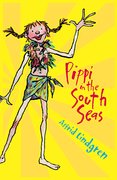
Pippi in the South Seas Adding to the fun of the Pippi books is the way she plays with language, inventing and mispronouncing words and names, singing nonsense songs, telling jokes and making up riddles. Obviously, this sets her translators a particularly tricky challenge! In the US Pippi Longstocking was translated in 1950 by Florence Lamborn, while it was translated in the UK by Edna Hurup in 1954 and published by Oxford University Press. Meanwhile, Pippi Goes Aboard (1956) and Pippi in the South Seas (1957) were translated by Marianne Turner. For a detailed comparison of these US and UK versions, see here: Pippi Goes Abroad by Madelene Moats.

Somehow, Pippi Longstocking completely passed me by as a child. Not only did I never read them, I'd never even heard of the books until they began to crop up regularly in discussions of children's literature in translation. So, coming to write about Astrid Lindgren now, I had some catching up to do...
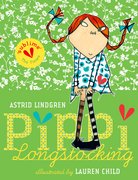
Pippi Longsticking, illustrated by Lauren ChildI read the newest translation by Tiina Nunnally (also OUP), published in 2007 and illustrated by Lauren Child of Charlie and Lola fame. Nunnally's translation is described as "sparkling" by the publishers and it certainly reads well. Combined with Child's illustrations it brings a modern air to the book - there are a lot of typographical quirks strongly reminiscent of the Charlie and Lola books. Judging by the examples in the essay I linked to above, it seems closer to the Lamborn translation than the Hurup - perhaps unsurprisingly as Nunnally is also American. She has a deft touch with the word play too - just to use one of the examples quoted by Moats, Pippi makes up a little rhyming ditty as she cooks pancakes for her friends.

The Swedish text is as follows (the normal word for pancake is pannkaka so an extra syllable has crept in there too):
Nu ska här bakas pannekakas,
nu ska här vankas pannekankas,
nu ska här stekas pannekekas. (1945:14)
Pippi Longstocking, Puffin Classics version
Hurup's version completely ignores the rhyme and the nonsense:

Here pancakes will be baked now,
here pancakes will be served now,
here pancakes will be fried now! (1954: 9)
Lamborn has:

Now we’re going to make a pancake
now there’s going to be a pankee
now we’re going to fry a pankye. (1977: 20)
We can now bring the comparison up to date by adding Nunnally's version:
Now it's time to make pancakes,
now it's time to flip panclips
now it's time to shape panchapes! (2007: 20)
To me, the last of these is the punchiest - Lamborn's is OK but doesn't scan so well.

From the reviews on Amazon it seems as though this version is succeeding in bringing in new readers attracted by the familiar style of the illustrations, which can only be a good thing. The physical book is also lovely and well produced. My only gripe is that the author and illustrator each get half-page biographies at the back of the book as well as name checks on the back cover and flaps. The translator, who has surely done as much as, if not more than, Lauren Child to make this book work just gets her name on the title page and the aforementioned "sparkling" in the blurb.


Friday, 11 May 2012

J is for Joëlle Jolivet and Jean-Luc Fromental...

... both French, he is a highly successful journalist, travel writer and author of novels, children's books and comics; she is an acclaimed designer and illustrator. They have collaborated on several books, including 365 Penguins. Sadly, the translator is uncredited, but the (American) English version was published by Abrams in 2006.
365 Penguins

In it, a family receive an unexpected parcel on New Year's Day. It contains a penguin and an anonymous note:
"I'm number 1. Feed me when I'm hungry."
The penguins keep coming; they're cute at first but soon start to cause problems. How do you house them, feed them, clean them? And who's sending them? And why?! Along the way, the family find themselves solving various mathematical problems in attempt to calculate their food requirements and storage solutions. By 31 December, their house is full of, you've guessed it, 365 penguins! One of them, named Chilly, has cute little blue feet. While they hold their New Year's Eve party on the lawn the sender of the penguins turns up.

It's Uncle Victor, the ecologist. He's been so worried about the penguins losing their habitat that he decided to resettle them at the North Pole instead. As you can't just export theatened species, he's been sending them one at a time. Now he takes them off in his van, leaving just Chilly as a pet. Things get back to normal until one day a new parcel arrives...

Now, this is an odd one. I want to like it - it's about penguins, and it sneakily teaches kids maths and a lesson about global warming. The illustrations are fun and very expressive. But, but, but, the whole thing sets my inner pedant screaming! What kind of ecologist would come up with such a harebrained and irresponsible plan? Given that the world is heating up, why would the penguins do any better at the North Pole anyway? And that's without even considering the cruelty of sending an animal by post! (Yes, I know. But this stuff bothers me. See this old post here: On Thomas, the Little Red Train etc.)

And another thing, the actual book is enormous. It doesn't fit in the bookcase and it's very hard to hold with a wriggling child on your lap.

On the other hand, the boys love it. Spotting Chilly with his blue feet is an extra game and of course they don't care in the least about the implausibility of it. Hopefully they will also pick up some of the mathsy stuff along the way.

Jolivet and Fromental seem to have made quite an industry out of penguins now and the pop-up book 10 Little Penguins looks charming too. Some pictures of the inside of the German edition can be seen here: fine fine books.

10 Little Penguins

Thursday, 10 May 2012

I is for Isol...

... the author of It's Useful to Have a Duck an unusual and charming accordion-style book that gives you two different viewpoints on the same situation. Originally published in Spanish as Tener un patito es útil, it was translated by Elisa Amado in 2009.

So, what's it about then? Well, a boy finds a duck and uses him, among other things, as a hat, a rocking horse and to clean his ears, before abandoning him in the bath. Quite cute. And then you turn the book over and read the blue pages. Suddenly the book is called It's Useful to Have a Boy. A duck finds a boy and uses him, among other things, as a vantage point on the world, to scratch his back and to polish his bill, before having a swim in the bath and settling down to sleep.

We picked up a second-hand copy recently and both boys took to it straight away. The board book format ought to suggest that it's more suitable for fils cadet (aged 2), but it was fils aînée (aged 5) who was able to appreciate the twist on the blue pages - and highly amusing he found it, too. Definitely recommended, and not just for children!

Saturday, 5 May 2012

D is for Duquennoy

Ghost Party by Jacques Duquennoy
Jacques Duquennoy is an author I'd never heard of until recently, but then fils aîné brought Ghost Party home from school and it became a major part of our lives. Translated from the French by Antonia Parkin and published by Frances Lincoln Children's Books in 2004, it stars a ghost named Henry who invites his ghostly friends round to the castle for a dinner party. With each course, the guests turn the colour of the food or drink they're consuming, until the final flourish - dessert so light it melts in the mouth, making Henry and his friends vanish altogether. That's pretty much it for the plot, but the boys love it! In fact fils aîné (aged 5) says it's his "best book ever". I've just checked with him about what he likes best and he says "when they change colour and when they go invisible". Fils cadet (aged 2) says his favourite part is when Henry says "Boo!"

As this demonstrates, the illustrations are simple but fun, and Henry gets up to all kinds of tricks. Since we first made Henry's acquaintance, he has reappeared in the book bag several times and also been borrowed from the library.

There seems also to be an older, out of print, translation called Phantom Feast, published by Orchard Books in 1994, translator unknown. And, in the course of researching this post, I discovered to my joy that there are other books in the series to look out for... Loch Ness Ghosts and The Ghosts in the Cellar. Mind you, I won't be paying £128.92 for that last one, even if it is a first edition!

We managed to borrow Loch Ness Ghosts (Frances Lincoln, 2005, tr. Antonia Parkin) from the library today and fils aîné reports that he maybe even likes it a little bit better than Ghost Party, which is saying something!

Henry reads in the newspaper that the Loch Ness Monster has been spotted again so he sets off with three friends to try and find it. Obviously, a bagpipe playing Scottish ghost by the name of MacShortbread lives in the castle on the loch and he helps them in their search. Now, in the best traditions of farce, Nessie appears behind the ghosts every time they turn away - the boys find this hysterical and scream "it's the monster!" They go home disappointed, but when they get their photos developed (yes, the French edition predates digital cameras!), there's a surprise in store...

Loch Ness Ghosts