Showing posts with label recommendations. Show all posts

Sunday, 27 May 2012

Y is for Kazumi Yamoto

Kazumi Yamoto is a Japanese author and musician. Her books for children and young adults often portray life in an ordinary Japanese home, and also deal with difficult issues like illness and death.

The Friends and Letters from the Living do so for young adults while The Bear and the Wildcat tackles similar themes for younger children.

Originally published in Japan in 2008, Cathy Hirano's elegant translation was published in 2011 by Gecko Press. Their strapline is "Curiously good books from around the world", which seems an excellent goal for a publisher! It also features lovely black and white illustrations by Komako Sakai, one of the most popular illustrators in Japan.


It's a sensitive and touching story of Bear, whose best friend the little bird has died. For a long time he is inconsolable, but eventually he ventures out and meets a wildcat who helps him to come to terms with his loss and face the future. Bear is able to remember the happy times he shared with the bird.

I've borrowed a copy from the library, and it has come from the bereavement section. Now I've written about it, I'll have to return it as soon as possible, just in case there's anyone out there who needs it.

Friday, 18 May 2012

Q is for Québec

A guest post by Katy Manck as part of the WordCount Blogathon 2012:

When we first meet Sam in his small Québec hometown in The Book of Time, he’s sure that the junior high bully is going to beat him up. By the end of this compelling young adult trilogy, Sam has become stronger in many ways – as a friend to his cousin Lucy, as a quick thinker and problem solver, as a person who can resist the temptations of easy illegal riches, and as a young man who knows that the perils of going into high school are nothing compared to what he’s faced during his time travels.

Series author Guillaume Prévost is a history professor in France and has also written novels for adults – all in French. In a 2007 interview, he stated how much he enjoyed having William Rodarmor translate all three books in The Book of Time series, as Rodarmor frequently consulted him to clarify historical points and plot nuances. When his adult novels were translated, Prévost had very little involvement with the process.

As a reader, I feel that having the same translator for the entire series kept the narrative flow clear and the characters’ voices distinct as we hurtled back and forth through Time together. For more details (but no plot spoilers) about the books, please click on each title below to open my recommendation in a new window/tab:

The Book of Time (#1) introduces Sam, his recently bereaved father, and their shared gift of traveling through time using the sunstone and special coins.

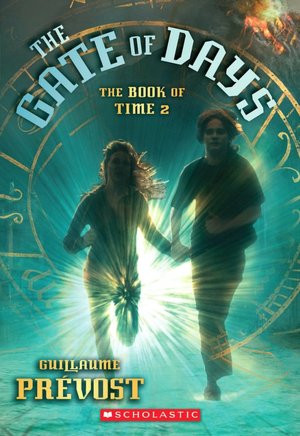
The Gate of Days (#2) takes Sam and his cousin Lucy to the castle of Vlad Tepes, Chicago’s gangster days, and rumbling Vesuvius as they search for Sam’s dad.

The Circle of Gold (#3) that enables time-travel from any location is what the Archos man seeks, so he holds Sam’s girlfriend hostage in Renaissance Rome until it is found.


Will Sam, his dad, Lucy, and Alicia all get back to Québec safe and sound?
Will the mysterious Archos man be defeated?

Katy ManckYou’ll have to read The Book of Time series to find out!

Check your local library, bookstore, or the publisher:
USA: Arthur A. Levine Books – all 3 books in hardcover
UK: Scholastic Books – first 2 books in paperback
Canada: Scholastic Books – book 1 in paperback

**Katy Manck, MLS
http://BooksYALove.blogspot.com
follow me on Twitter: @BooksYALove


About the author: Katy Manck is a retired academic/corporate/school librarian who finds joy in recommending young adult books beyond the bestsellers on her BooksYALove blog. She is treasurer of the International Association of School Librarianship and publicity chair for IASL’s free online international GiggleIT Project for student writers.

Tuesday, 15 May 2012

O is for Outside In

O is for Outside In:
"the organisation dedicated to promoting and exploring world literature and children's books in translation." 
 I have found this website of enormous help in compiling and researching this A-Z, and the nice people there provide all kinds of ways to discover new books. You can search for a specific author or  title, browse by age range or choose a country from an interactive map of the world. Or you can have a look at their book of the week. Not all the books are translations, incidentally - some are written in English by international authors.

There is also information on their work bringing international books to children in the UK and a whole range of schemes and events supporting translated children's literature: it really is a worthwhile site to check out!

Meanwhile, here's a range of translated picture books beginning with 'O' that I found there - follow the links below the images to read their reviews:

Odd Bird Out
Odd Bird Out

Oink, Oink Benny
Oink, Oink Benny

On the Farm
On the Farm


Oscar and the Very Hungry Dragon

Saturday, 12 May 2012

K is for Kaaberbøl

Lene Kaaberbøl to be precise, who is interesting because she translates her own books into English from her native Danish. I don't know of any other instances in children's literature, although I'm sure someone will be able to correct me on that. Self-translation undoubtedly has many advantages - the author/translator knows their own text better than anybody and never has to wonder exactly what some phrase or other means. It also requires a bilingual fluency of a sufficiently high level to be able to write as well in another language as you can in your own - a skill of which I am frankly in awe!

To get a taste of her writing for this A-Z project, I read Kaaberbøl's Silverhorse. The publishers, MacMillan Children's Books, have let this and the sequel Midnight go out of print, which is a shame because it's an excellent book. It is set in a post-apocalyptic world where nobody is allowed to own the land, but it is passed down from mother to daughter. Women are the rulers with a duty to care for the land, and men lead an itinerant life. The main character is 12-year-old Kat, daughter of Tess, the maestra of Crowfoot Inn. Kat has a fiery temper and fights constantly with her stepfather. In the end, Tess has no choice but to send Kat away, despite it being very unusual for a girl to travel in this society. After a disastrous apprenticeship to a dyer, she ends up at the academy for Bredinari, who ride the strange and dangerous hellhorses - wild nightmares crossed with sturdy mountain horses - and serve justice and law in the land of Breda. Here, Kat has to learn to control her temper so she can master the weapons and horses she will need to handle. Events come to a head when she gets caught up in power politics beyond her control or understanding, and finds herself fighting for survival.

The plot rattles along at a good pace and Kat is an engaging and sympathetic, if flawed, character. Her struggles with both authority figures and bullies her own age are all too recognisable and the book also tackles the reverse-sexism of her world, snobbery, loyalty, betrayal and true friendship.

I found that as I was reading, I was constantly trying to second-guess Kaaberbøl - had she used this word or that (injust, for example) deliberately for archaic effect or by mistake? - a trap that is all the easier to fall into when the author/translator is known to be writing in a language not her mother tongue. I also found myself irritated by the interjection 'Sweet Our Lady!' - coming from a Christian tradition, I would have found 'Our sweet Lady' or even 'Sweet Lady!' more natural, but then perhaps she was deliberately trying to distance herself from 'Our Lady' as the Virgin Mary... That said, the writing is truly fantastic, in every sense of the word.

Highly recommended!

Thursday, 10 May 2012

I is for Isol...

... the author of It's Useful to Have a Duck an unusual and charming accordion-style book that gives you two different viewpoints on the same situation. Originally published in Spanish as Tener un patito es útil, it was translated by Elisa Amado in 2009.

So, what's it about then? Well, a boy finds a duck and uses him, among other things, as a hat, a rocking horse and to clean his ears, before abandoning him in the bath. Quite cute. And then you turn the book over and read the blue pages. Suddenly the book is called It's Useful to Have a Boy. A duck finds a boy and uses him, among other things, as a vantage point on the world, to scratch his back and to polish his bill, before having a swim in the bath and settling down to sleep.

We picked up a second-hand copy recently and both boys took to it straight away. The board book format ought to suggest that it's more suitable for fils cadet (aged 2), but it was fils aînée (aged 5) who was able to appreciate the twist on the blue pages - and highly amusing he found it, too. Definitely recommended, and not just for children!

Saturday, 5 May 2012

D is for Duquennoy

Ghost Party by Jacques Duquennoy
Jacques Duquennoy is an author I'd never heard of until recently, but then fils aîné brought Ghost Party home from school and it became a major part of our lives. Translated from the French by Antonia Parkin and published by Frances Lincoln Children's Books in 2004, it stars a ghost named Henry who invites his ghostly friends round to the castle for a dinner party. With each course, the guests turn the colour of the food or drink they're consuming, until the final flourish - dessert so light it melts in the mouth, making Henry and his friends vanish altogether. That's pretty much it for the plot, but the boys love it! In fact fils aîné (aged 5) says it's his "best book ever". I've just checked with him about what he likes best and he says "when they change colour and when they go invisible". Fils cadet (aged 2) says his favourite part is when Henry says "Boo!"

As this demonstrates, the illustrations are simple but fun, and Henry gets up to all kinds of tricks. Since we first made Henry's acquaintance, he has reappeared in the book bag several times and also been borrowed from the library.

There seems also to be an older, out of print, translation called Phantom Feast, published by Orchard Books in 1994, translator unknown. And, in the course of researching this post, I discovered to my joy that there are other books in the series to look out for... Loch Ness Ghosts and The Ghosts in the Cellar. Mind you, I won't be paying £128.92 for that last one, even if it is a first edition!

We managed to borrow Loch Ness Ghosts (Frances Lincoln, 2005, tr. Antonia Parkin) from the library today and fils aîné reports that he maybe even likes it a little bit better than Ghost Party, which is saying something!

Henry reads in the newspaper that the Loch Ness Monster has been spotted again so he sets off with three friends to try and find it. Obviously, a bagpipe playing Scottish ghost by the name of MacShortbread lives in the castle on the loch and he helps them in their search. Now, in the best traditions of farce, Nessie appears behind the ghosts every time they turn away - the boys find this hysterical and scream "it's the monster!" They go home disappointed, but when they get their photos developed (yes, the French edition predates digital cameras!), there's a surprise in store...

Loch Ness Ghosts


Wednesday, 11 April 2012

Is That a Fish in Your Ear?

Is That a Fish in Your Ear?I've been meaning to review Is That a Fish in Your Ear? Translation and the Meaning of Everything by David Bellos for some time now, having been given it for Christmas. I found it a fascinating book and very entertaining, although not always as playful as its title. Whether or not it would be such an easy read for somebody with no prior knowledge of translation, I don't know, but I enjoyed the chatty, annecdotal tone as well as insights into aspects of the profession I'm unfamiliar with. The history of simultaneous interpreting, for example, or the mechanics of translation at the EU or the UN, as well as the dragomen of the Ottoman Empire. I also appreciated Bellos' spirited defense of the importance and possibility of translation - he firmly believes that everything can be translated - and the way he takes issue with the idea of les belles infidèles (beautiful but unfaithful, whether referring to women or translation),  poetry getting "lost in translation", that translation is no substitute for the original, and so on.

(I must confess that I was rather childishly pleased to see lolspeak among the languages into which the title is translated on the inside cover of the book: U has gots fish in ur eer?!11 Translayshun and da Meening of stuffz...)

I am, however, less convinced than he seems to be about the usefulness of Google translate, having seen articles like this one, for example, although I take his point that a sentence such as:
"On the part of for the protection of the mansion building occurring it was made valid that a feedback of the building condition was not at all possible on the time Klimts due to documentation lacking."
 is clearly nonsense, where an inaccurate translation produced by a human being would be impossible to spot without knowledge of both languages.

 This is such a comprehensive survey of the history and practice of translation that it would be impossible to summarise here. If you think it's going to be about The Hitchhiker's Guide to the Galaxy (as some Amazon reviewers seem to have done), then you might be in for a disappointment. If, on the other hand, you're even the slightest bit interested in words, language or what it is that translators and interpreters actually do then I'd highly recommend that you read this book! 


Sunday, 1 April 2012

Anything by Emily Gravett

My current answer when asked for picture book recommendations is "Anything by Emily Gravett," and here's why: I haven't yet come across one of her books that I haven't liked, and they're big hits with the boys too. All her books are beautiful, as befits someone who has twice won the Kate Greenaway Medal for illustration, and the stories are equally charming.

Fils cadet is particularly taken with Blue Chameleon at the moment, while Fils aîné prefers Again!

Blue Chameleon by Emily GravettAgain by Emily Gravett
Blue Chameleon is very simple and definitely more suited to younger ones, yet it has plenty to discuss on each page. It tells the story of a little chameleon looking for a friend and adapting its shape and colour to match the various objects it finds along the way - a snail, a sock and a cowboy boot, for example. As well as spotting the colours, we can discuss the way the chameleon is feeling as it gets progressively more dejected until at last it meets another chameleon and the two walk off together in a joyful explosion of colours.

Again! introduces a scenario familiar to every parent and child at bedtime. Cedric the little dragon has one favourite story, and he wants his mum to read it. And again, and again, and again! Dragons being what they are, when Cedric loses his temper, the results are startling and very funny. Fils aîné thinks so anyway, bounding around with excitement and bellowing "again!" I, on the other hand, find myself entirely in sympathy with Cedric's mum, wearily changing the story with each repetition before falling asleep herself...

Both of these are books we've had out of the library before, and have out of the library at the moment, and undoubtedly will have out of the library again in the future, given the rapture with which they were rediscovered last week. Others that I'd particularly recommend are Meerkat Mail for older children and Orange, Pear, Apple, Bear for younger ones. But like I said, anything by Emily Gravett is bound to be good!