Thursday, 10 May 2012

I is for Isol...

... the author of It's Useful to Have a Duck an unusual and charming accordion-style book that gives you two different viewpoints on the same situation. Originally published in Spanish as Tener un patito es útil, it was translated by Elisa Amado in 2009.

So, what's it about then? Well, a boy finds a duck and uses him, among other things, as a hat, a rocking horse and to clean his ears, before abandoning him in the bath. Quite cute. And then you turn the book over and read the blue pages. Suddenly the book is called It's Useful to Have a Boy. A duck finds a boy and uses him, among other things, as a vantage point on the world, to scratch his back and to polish his bill, before having a swim in the bath and settling down to sleep.

We picked up a second-hand copy recently and both boys took to it straight away. The board book format ought to suggest that it's more suitable for fils cadet (aged 2), but it was fils aînée (aged 5) who was able to appreciate the twist on the blue pages - and highly amusing he found it, too. Definitely recommended, and not just for children!

Wednesday, 9 May 2012

H is for Hergé

Confession time - I was always a very partisan child so, being devoted to Asterix, I never read Tintin. So for today, here's a guest post by my husband and proofreader-in-chief:


The cast of the Adventures of Tintin
The cast of The Adventures of Tintin


H is for Hergé, but really, there’s only one thing anyone thinks of when they hear his name – Tintin.

What’s so great about Tintin? To be honest, that’s a question I’ve asked myself before, since discovering him aged 10 or 11. I loved the books back then, devouring them avidly, and I still have a huge amount of affection for them, but reading Tintin as an adult, it’s hard to pin down exactly where the appeal lies.

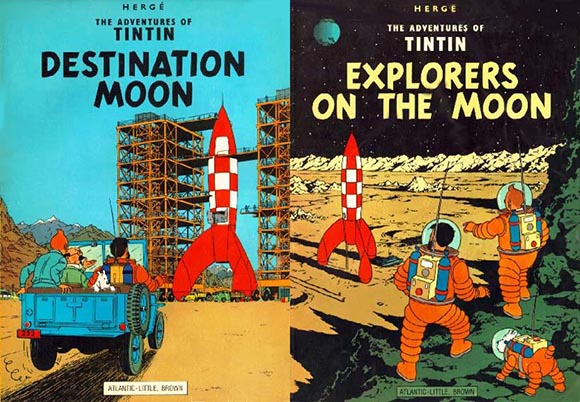
The books are certainly of their time – leaving aside some slightly dubious racial attitudes (even apart from the notorious Tintin in the Congo), the modern reader may be surprised to see just how much smoking and heavy drinking there is, something I can’t imagine in more modern books. And in the moon landing stories (Destination Moon, Explorers on the Moon) there’s a jarring reminder that they were written several years before the first launch of the Sputnik Programme, and are closer to Jules Verne and H.G. Wells than modern science fiction.
Tintin - Destination Moon and Explorers on the Moon

The characters are drawn with very broad brushes, becoming archetypes if you’re generous, stereotypes if you’re not – the brave young hero, the salty sea-dog and the brilliant but absent-minded professor are all present and correct, while the villains tend to scowl a lot, smoke cigars and regularly use chloroform to abduct people. Maybe this simple characterisation, along with the slightly “boys’ own” style, is what makes it so accessible across cultures.

While not being packed with puns in the manner of Asterix, for example, the English translations of Tintin still attempt to replicate the humour and wordplay in the originals. Dialogue gets tweaked to make convincing jokes based on Professor Calculus mishearing things, and in Tintin and the Picaros the translators, Leslie Lonsdale-Cooper and Michael Turner, take full advantage of Hergé’s invented language. The speech of the Arumbaya Indians looks foreign, but resembles appropriate English phrases when spoken aloud (e.g. “Oozfah sek 'unds” meaning “who’s for seconds?”), and their name for the pyramid, Hotwattabottl, hopefully needs no further explanation.

It’s easy to be negative about Tintin, especially in light of recent rows about racism, but the books have an enduring appeal. These ripping yarns are possibly a little dated, but they still wear the years well as an artefact of a more innocent time, when good guys wore white hats and bad guys wore black hats, smoking was a harmless pleasure, and the natural instinct of a villain was to lock you up somewhere until they’d carried out their evil scheme.

So I enjoy them for what they are - gripping adventures in a variety of settings with some truly iconic cartoon imagery, perfect escapist reading matter.

Tuesday, 8 May 2012

G is for Grimm

The Brothers Grimm
 Elisabeth Jerichau Baumann [Public domain], via Wikimedia Commons
The Brothers Grimm, Jacob (above, right) and Wilhelm (above, left), surely need little introduction. Their collection of German folktales in the 19th century has formed the basis of a wealth of children's literature and film around the world.

Mostly, though, we get re-tellings or adaptations of the stories. Concerns about violence and their suitability for children date right back to the first publication of Children's and Household Tales so they have been sanitised, tidied up and disneyfied many times over the years.

I wanted to re-read the original tales but my copy is 100 miles away in my parents' house. But then inspiration struck - this is the 21st century, the old translations are in the public domain, I've got an eReader... So, off I went to Project Gutenberg and hey presto, a free download of the 1884 edition, translated by Margaret Hunt and published as Grimm's Household Tales. A note before the text informs me that "Margaret Hunt's translation is very true to the German original", and on comparison with the German text of the first story The Frog King, (which is available here on wikisource.de: Der Froschkönig) it certainly is. Personally, I would prefer a slightly freer and more idiomatic translation - the use of "thou" to translate du is both archaising and distancing, for example - but then I'd have to pay for it!

This one, for instance, The Fairy Tales of the Brothers Grimm, looks lovely and I'm encouraged that the translator, Matthew R. Price, has been given space for a translator's note on the webpage as well as in the book. He says:
The Fairy Tales of the Brothers Grimm
Taschen edition
"initially I had little sense how best to unpack these stories for today’s English-speaking readers—and listeners. I leaned on my training: countless hours of living with the language, and theatrical instincts I’d honed for years. In my mind I saw fantastic animated films as I worked through these stories. They were dark, complex, and arcing versions, not the Disney films associated with the material. There is no denying the unforgiving morality or the harshness of daily life one finds in the tales. But even more striking, finally, was the full range of emotion, especially the comedy and delight of the characters and their antics."
Source: http://www.taschen.com/pages/en/catalogue/classics/all/06787/facts.the_fairy_tales_of_the_brothers_grimm.htm 

Vintage Grimm: The Complete Fairy Tales
 Then there's the Vintage Classics edition, translated and with an introduction by Jack Zipes, an expert on fairytales and retired professor of German. It claims to be the only complete edition of all 279 tales - I certainly had no idea how many of them there were before I started researching this!

Now, this is a confusing one: Wordsworth Editions have three versions, including The Complete Illustrated Tales of The Brothers Grimm, apparently illustrated by Arthur Rackham (which from the cover looks frankly improbable) and containing "darker tales such as 'Death's Messengers' which deserve to be better known". The translator is uncredited, yet the cover looks sweet and childish. Then there's Grimm's Fairy Tales, selected and translated by Lucy Crane, and "illustrated throughout by Walter Crane's charming line drawings." So is the other version translated by Lucy Crane too? Who knows?

Wordsworth Editions: The Brothers GrimmWordsworth Editions: Grimm's Fairy Tales


So there you are. You pays your money and you takes your choice. Or you get them for free and put up with the thees and thous.

Monday, 7 May 2012

F is for Cornelia Funke

Cornelia Funke is a hugely successful, award-winning German author of fantasy and adventure books for children of all ages - they range from picture books to young adult novels. She started out as an illustrator before beginning to write herself and became very popular in Germany in the nineties before her books began to become known in English a decade or so later. She is probably best known for the Inkworld trilogy, the first book of which, Inkheart, was also made into a 2008 film with what you might call an all-star cast.

The Princess KnightI was just about to write that Funke is an author I hadn't previously read, when I checked her publications list and realised that fils aîné had borrowed The Princess Knight (tr. Anthea Bell, Chicken House, 2003) from the library a while ago. It's the story of the entirely non-girly Princess Violetta who wants to be a knight like her brothers and is disgusted when her father holds a tournament with her hand in marriage as the prize. With ingenuity and determination, "Little Vi" manages to outwit them all and choose her own path in life. It's also beautifully illustrated by Kerstin Meyer and a welcome antedote to all the Disney princess stuff that makes me glad to have boys!


Anyway, although I was aware of the Inkworld trilogy, I hadn't read any of Funke's fantasy novels because they came along too late for my childhood and the boys are still too young for them. In the last couple of weeks, I've read Igraine the Brave (tr. Anthea Bell, Chicken House, 2008) and Dragon Rider (tr. Anthea Bell, Chicken House, 2005) and hope that they provide a fairly representative sample of her work - I couldn't get hold of Inkheart etc in time for this project.

Igraine the BraveIgraine is another little girl who wants to be a knight. The book is for younger children, 7+ according to the publishers, and I hope it's the sort of thing fils aîné might be getting round to before long.  Her parents are famous magicians who manage to accidentally transform themselves into pigs. This means that Igraine has to put things right, meeting dragons, giants and all kinds of adventures on the way. It would be a good introduction to chapter books, chivalry, knights in armour and so on because none of the dangers ever get beyond what the film industry calls "mild peril", and it's short at 224 pages. It is also wittily told by both Funke and Bell, and illustrated by the author.


Dragon RiderDragon Rider, also illustrated by Funke herself, is a more ambitious undertaking altogether. Weighing in at 560 pages, it's for the 10+ age group and tells the story of a dragon named Firedrake, a brownie named Sorrel and a boy named Ben. Together they set off on an epic journey to find the long-lost valley where the last dragons can live in peace, undisturbed by human greed. Of course there are plenty of dangers to be overcome here too, and an ancient enemy is on their trail... Reading as an adult, I quite enjoyed it but felt that it lacked depth. The characters seemed rather too obvious, the dangers rather easily overcome. And I do always feel a little irritated when the journey out takes 550 pages and the return leg can be summed up in a couple of lines! Probably despite the length and the 10+ label it might be suited to a younger audience still. I can imagine that in a few years' time, the boys will love it.


Sunday, 6 May 2012

E is for 'Emil and the Detectives'

Emil and the Detectives by Erich Kästner was first published in Germany in 1929 and had its first UK edition not long afterwards, in 1931. Gillian Lathey has argued that Emil was the Harry Potter of his day in terms of the appeal to children, the buzz around the book and the freshness of the writing in comparison to what had gone before. For more details see this article from New Books in German. It was the first book to feature a child as a detective and, in a radical departure for children's books of that time, used the street slang of Berlin in the dialogue.
Emil and the Detectives, original German cover.
Original German cover

Emil is sent by his mother to Berlin by train with a substantial sum of money for his grandmother. On the way, his money is stolen and the adventure consists of him tracking down the thief, with the help of a group of other boys, and retrieving the money. We read this book in primary school but most of what I remember about it from that time was my Dad's anguish at my excruciating pronunciation of the unfamiliar German names... (My accent has improved at least slightly since then.) I had certainly forgotten that there is a goodly chunk of book on either side of the actual detecting - I was quite surprised how soon the villain was caught as it seemed to take weeks in my memory. Due to the pace of reading in class, no doubt. Anyway, it then transpires that the thief was a wanted bank robber, Emil gets a huge reward and his mother comes to Berlin for a party. The moral of the story may, or may not, be: never trust strangers, "children shouldn't be allowed to travel alone", or that "money should always be sent through the post!"
Emil and the Detectives, Puffin edition
This is the cover I remember from school...

There is an array of English translations out there: the first UK one was done by Margaret Goldsmith in 1931 and another in 1959 by Eileen Hall, which is the one still in print as a Red Fox Classic. I haven't read the Goldsmith version, but I understand that, like Hall, she rather unfortunately makes the Berlin street slang sound more like something out of the mouths of Enid Blighton's nice middle class children. See also here for more discussion of this issue...
Emil and the Detectives, Red Fox Classics
Red Fox Classics edition, tr. Eileen Hall

As a child, I had no idea of how the original text was written and, being more than a little addicted to the Famous Five, I was unperturbed by dialogue like:
 "Cheerio Emil. Gosh, I'm looking forward to this. It's going to be smashing!" (p. 92) 
 On my recent re-reading, though, I was aware that I'd have a completely different idea of the backgrounds of the various children without prior knowledge of the source text.

More disconcerting is the fact that Emil's 120 marks, his mother's monthly salary, has become "seven pounds". With the effects of inflation, this gives modern children no idea at all of just how much money is at stake. Besides which, given that Hall has scrupulously maintained the German names of both people and streets, it is most incongruous for the boys to be talking about shillings, "one and eightpence", "ten bob" etc.

Emil and the Detectives, US edition, tr. May Massee
US edition, tr. May Massee
In the US, meanwhile it was translated in 1930 by May Massee who, according to Lathey, kept a much more plausible tone to the dialogue:
 "the American translation [...] is far closer to the original German in its rendering of street slang than the conservative British version with its entirely inappropriate middle class register." Source: http://www.erudit.org/revue/meta/2003/v48/n1-2/006970ar.html?vue=resume
As far as I'm aware, she also maintained the German marks.

A new American version by W. Martin has also recently been published, which curiously changes Emil's surname from Tischbein (table leg) to "Tabletoe", and has had mixed reactions to its attempts to update the slang.

Finally, there is a Penguin Readers edition, retold (and apparently considerably abridged) by Rod Smith. This changes Emil's surname to Fisher, his friend Gustav's name to Paul and moves the action to England, Emil now coming from Newtown rather than Neustadt.

So there we are. Plenty to chose from.

But after all that, if there are any publishers reading this, and you'd like to take up the challenge of producing a version for the 21st century, I'd be very willing to help you out...


Saturday, 5 May 2012

D is for Duquennoy

Ghost Party by Jacques Duquennoy
Jacques Duquennoy is an author I'd never heard of until recently, but then fils aîné brought Ghost Party home from school and it became a major part of our lives. Translated from the French by Antonia Parkin and published by Frances Lincoln Children's Books in 2004, it stars a ghost named Henry who invites his ghostly friends round to the castle for a dinner party. With each course, the guests turn the colour of the food or drink they're consuming, until the final flourish - dessert so light it melts in the mouth, making Henry and his friends vanish altogether. That's pretty much it for the plot, but the boys love it! In fact fils aîné (aged 5) says it's his "best book ever". I've just checked with him about what he likes best and he says "when they change colour and when they go invisible". Fils cadet (aged 2) says his favourite part is when Henry says "Boo!"

As this demonstrates, the illustrations are simple but fun, and Henry gets up to all kinds of tricks. Since we first made Henry's acquaintance, he has reappeared in the book bag several times and also been borrowed from the library.

There seems also to be an older, out of print, translation called Phantom Feast, published by Orchard Books in 1994, translator unknown. And, in the course of researching this post, I discovered to my joy that there are other books in the series to look out for... Loch Ness Ghosts and The Ghosts in the Cellar. Mind you, I won't be paying £128.92 for that last one, even if it is a first edition!

We managed to borrow Loch Ness Ghosts (Frances Lincoln, 2005, tr. Antonia Parkin) from the library today and fils aîné reports that he maybe even likes it a little bit better than Ghost Party, which is saying something!

Henry reads in the newspaper that the Loch Ness Monster has been spotted again so he sets off with three friends to try and find it. Obviously, a bagpipe playing Scottish ghost by the name of MacShortbread lives in the castle on the loch and he helps them in their search. Now, in the best traditions of farce, Nessie appears behind the ghosts every time they turn away - the boys find this hysterical and scream "it's the monster!" They go home disappointed, but when they get their photos developed (yes, the French edition predates digital cameras!), there's a surprise in store...

Loch Ness Ghosts


Friday, 4 May 2012

C is for...

Cinderella - Anne Anderson
'Cinderella' by Anne Anderson (1874-1930)
... Cinderella, source of one of the most famous translation myths in the world. It's widely believed that the glass slippers are the result of pantoufle de vair (fur slipper) being mistaken for pantoufle de verre (glass slipper) when Charles Perrault's French version of the tale was translated into English. I couldn't remember where I first read a debunking of this idea, but it seems quite likely that it was on fellow translator Jill Sommer's blog: Were Cinderellas Glass Slippers a Mistranslation? quoting snopes.com. Certainly fur slippers sound more comfortable than glass ones, but somewhat out of place at a royal ball!


I was also surprised to read the Grimm brothers' version of the story in which the fine clothes and slippers first "embroidered with silk and silver" and then "of pure gold" are thrown down - on three occasions - from a hazel tree over her mother's grave by a white bird who grants her wishes - no fairy godmothers, pumpkin coaches or enchanted footmen in sight. I wonder why Perrault's telling has stuck in this country rather than any of the countless other variations out there...
 
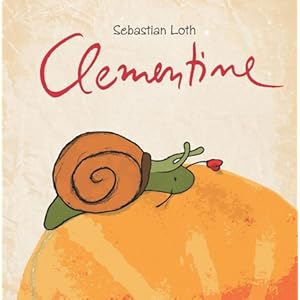
C is also for Clementine by Sebastian Loth and Chih-Yaun Chen, author of Guji-Guji - two books which sound like a lot of fun and which I am adding to my mental wishlist for the boys...  Reviews can be found at Outside In Inside Out.
Guji-Guji by Chen Chih Yuan

"Once upon a time, a very strange egg rolled into Mother Duck’s nest. When a baby crocodile hatched, she thought nothing of it and raised Guji Guji along with the rest of her ducklings… as a duck. Everyone gets on fine until some big bad crocodiles turn up one day. The big crocs make Guji Guji question who he is and want him to place his duck family in danger. What will Guji Guji do? Is he a crocodile? Is he a duck? Will he save his family or side with his species?"

http://www.outsideinworld.org.uk/bookdetail.asp?start=1&textpage=&mainpage=&id=162


Clementine by Sebastian Loth
"Clementine the snail loves everything round—hoops, wheels, balls, balloons and most of all, the moon. She longs to glide gently over the moon’s surface so she makes a daring decision— "I'm going to fly to the moon," she whispered into the night . . ." Her best friend Paul helps her to find an ingenious way to travel to the moon and soon Clementine is setting out on the most amazing journey."  

http://www.outsideinworld.org.uk/bookdetail.asp?start=1&textpage=&mainpage=&id=1360
 If you've read either of these, I'd be happy to hear what you thought of them!