Showing posts with label recent reads. Show all posts

Sunday, 13 May 2012

L is for Lindgren

German stamp from 2007 showing Astrid Lindgren and Emil


Astrid Lindgren is apparently the 18th most translated author in the world.  Also famous as an active campaigner for children's and animal rights, she wrote over 50 stories including the Emil, Karlson-on-the-Roof, Bill Bergson (Kalle Blomkvist in Swedish) and Bullerby children series. But she's best known for Pippi Longstocking, the strongest nine-year-old girl in the world.

Pippi lives alone (apart from a horse, and a monkey named Mr Nilsson) because her mother died when she was a baby and her father is lost at sea. She is fiercely self-sufficient but becomes good friends with the children next door, Tommi and Annika. Her lack of manners and education have made her contraversial with adults but incredibly popular with children ever since the first publication in 1945. It was  felt (and still is, in some quarters) that she encourages rudeness and disrespect. Yet many more people claim Pippi as a role model: a feisty, free-spirited figure showing that there's nothing girls can't do.
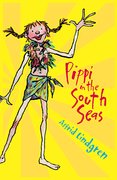
Pippi in the South Seas Adding to the fun of the Pippi books is the way she plays with language, inventing and mispronouncing words and names, singing nonsense songs, telling jokes and making up riddles. Obviously, this sets her translators a particularly tricky challenge! In the US Pippi Longstocking was translated in 1950 by Florence Lamborn, while it was translated in the UK by Edna Hurup in 1954 and published by Oxford University Press. Meanwhile, Pippi Goes Aboard (1956) and Pippi in the South Seas (1957) were translated by Marianne Turner. For a detailed comparison of these US and UK versions, see here: Pippi Goes Abroad by Madelene Moats.

Somehow, Pippi Longstocking completely passed me by as a child. Not only did I never read them, I'd never even heard of the books until they began to crop up regularly in discussions of children's literature in translation. So, coming to write about Astrid Lindgren now, I had some catching up to do...
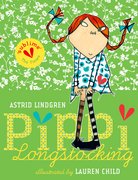
Pippi Longsticking, illustrated by Lauren ChildI read the newest translation by Tiina Nunnally (also OUP), published in 2007 and illustrated by Lauren Child of Charlie and Lola fame. Nunnally's translation is described as "sparkling" by the publishers and it certainly reads well. Combined with Child's illustrations it brings a modern air to the book - there are a lot of typographical quirks strongly reminiscent of the Charlie and Lola books. Judging by the examples in the essay I linked to above, it seems closer to the Lamborn translation than the Hurup - perhaps unsurprisingly as Nunnally is also American. She has a deft touch with the word play too - just to use one of the examples quoted by Moats, Pippi makes up a little rhyming ditty as she cooks pancakes for her friends.

The Swedish text is as follows (the normal word for pancake is pannkaka so an extra syllable has crept in there too):
Nu ska här bakas pannekakas,
nu ska här vankas pannekankas,
nu ska här stekas pannekekas. (1945:14)
Pippi Longstocking, Puffin Classics version
Hurup's version completely ignores the rhyme and the nonsense:

Here pancakes will be baked now,
here pancakes will be served now,
here pancakes will be fried now! (1954: 9)
Lamborn has:

Now we’re going to make a pancake, 
now there’s going to be a pankee, 
now we’re going to fry a pankye. (1977: 20)
We can now bring the comparison up to date by adding Nunnally's version:
Now it's time to make pancakes,
now it's time to flip panclips, 
now it's time to shape panchapes! (2007: 20)
To me, the last of these is the punchiest - Lamborn's is OK but doesn't scan so well.

From the reviews on Amazon it seems as though this version is succeeding in bringing in new readers attracted by the familiar style of the illustrations, which can only be a good thing. The physical book is also lovely and well produced. My only gripe is that the author and illustrator each get half-page biographies at the back of the book as well as name checks on the back cover and flaps. The translator, who has surely done as much as, if not more than, Lauren Child to make this book work just gets her name on the title page and the aforementioned "sparkling" in the blurb.


Saturday, 12 May 2012

K is for Kaaberbøl

Lene Kaaberbøl to be precise, who is interesting because she translates her own books into English from her native Danish. I don't know of any other instances in children's literature, although I'm sure someone will be able to correct me on that. Self-translation undoubtedly has many advantages - the author/translator knows their own text better than anybody and never has to wonder exactly what some phrase or other means. It also requires a bilingual fluency of a sufficiently high level to be able to write as well in another language as you can in your own - a skill of which I am frankly in awe!

To get a taste of her writing for this A-Z project, I read Kaaberbøl's Silverhorse. The publishers, MacMillan Children's Books, have let this and the sequel Midnight go out of print, which is a shame because it's an excellent book. It is set in a post-apocalyptic world where nobody is allowed to own the land, but it is passed down from mother to daughter. Women are the rulers with a duty to care for the land, and men lead an itinerant life. The main character is 12-year-old Kat, daughter of Tess, the maestra of Crowfoot Inn. Kat has a fiery temper and fights constantly with her stepfather. In the end, Tess has no choice but to send Kat away, despite it being very unusual for a girl to travel in this society. After a disastrous apprenticeship to a dyer, she ends up at the academy for Bredinari, who ride the strange and dangerous hellhorses - wild nightmares crossed with sturdy mountain horses - and serve justice and law in the land of Breda. Here, Kat has to learn to control her temper so she can master the weapons and horses she will need to handle. Events come to a head when she gets caught up in power politics beyond her control or understanding, and finds herself fighting for survival.

The plot rattles along at a good pace and Kat is an engaging and sympathetic, if flawed, character. Her struggles with both authority figures and bullies her own age are all too recognisable and the book also tackles the reverse-sexism of her world, snobbery, loyalty, betrayal and true friendship.

I found that as I was reading, I was constantly trying to second-guess Kaaberbøl - had she used this word or that (injust, for example) deliberately for archaic effect or by mistake? - a trap that is all the easier to fall into when the author/translator is known to be writing in a language not her mother tongue. I also found myself irritated by the interjection 'Sweet Our Lady!' - coming from a Christian tradition, I would have found 'Our sweet Lady' or even 'Sweet Lady!' more natural, but then perhaps she was deliberately trying to distance herself from 'Our Lady' as the Virgin Mary... That said, the writing is truly fantastic, in every sense of the word.

Highly recommended!

Monday, 7 May 2012

F is for Cornelia Funke

Cornelia Funke is a hugely successful, award-winning German author of fantasy and adventure books for children of all ages - they range from picture books to young adult novels. She started out as an illustrator before beginning to write herself and became very popular in Germany in the nineties before her books began to become known in English a decade or so later. She is probably best known for the Inkworld trilogy, the first book of which, Inkheart, was also made into a 2008 film with what you might call an all-star cast.

The Princess KnightI was just about to write that Funke is an author I hadn't previously read, when I checked her publications list and realised that fils aîné had borrowed The Princess Knight (tr. Anthea Bell, Chicken House, 2003) from the library a while ago. It's the story of the entirely non-girly Princess Violetta who wants to be a knight like her brothers and is disgusted when her father holds a tournament with her hand in marriage as the prize. With ingenuity and determination, "Little Vi" manages to outwit them all and choose her own path in life. It's also beautifully illustrated by Kerstin Meyer and a welcome antedote to all the Disney princess stuff that makes me glad to have boys!


Anyway, although I was aware of the Inkworld trilogy, I hadn't read any of Funke's fantasy novels because they came along too late for my childhood and the boys are still too young for them. In the last couple of weeks, I've read Igraine the Brave (tr. Anthea Bell, Chicken House, 2008) and Dragon Rider (tr. Anthea Bell, Chicken House, 2005) and hope that they provide a fairly representative sample of her work - I couldn't get hold of Inkheart etc in time for this project.

Igraine the BraveIgraine is another little girl who wants to be a knight. The book is for younger children, 7+ according to the publishers, and I hope it's the sort of thing fils aîné might be getting round to before long.  Her parents are famous magicians who manage to accidentally transform themselves into pigs. This means that Igraine has to put things right, meeting dragons, giants and all kinds of adventures on the way. It would be a good introduction to chapter books, chivalry, knights in armour and so on because none of the dangers ever get beyond what the film industry calls "mild peril", and it's short at 224 pages. It is also wittily told by both Funke and Bell, and illustrated by the author.


Dragon RiderDragon Rider, also illustrated by Funke herself, is a more ambitious undertaking altogether. Weighing in at 560 pages, it's for the 10+ age group and tells the story of a dragon named Firedrake, a brownie named Sorrel and a boy named Ben. Together they set off on an epic journey to find the long-lost valley where the last dragons can live in peace, undisturbed by human greed. Of course there are plenty of dangers to be overcome here too, and an ancient enemy is on their trail... Reading as an adult, I quite enjoyed it but felt that it lacked depth. The characters seemed rather too obvious, the dangers rather easily overcome. And I do always feel a little irritated when the journey out takes 550 pages and the return leg can be summed up in a couple of lines! Probably despite the length and the 10+ label it might be suited to a younger audience still. I can imagine that in a few years' time, the boys will love it.


Wednesday, 11 April 2012

Is That a Fish in Your Ear?

Is That a Fish in Your Ear?I've been meaning to review Is That a Fish in Your Ear? Translation and the Meaning of Everything by David Bellos for some time now, having been given it for Christmas. I found it a fascinating book and very entertaining, although not always as playful as its title. Whether or not it would be such an easy read for somebody with no prior knowledge of translation, I don't know, but I enjoyed the chatty, annecdotal tone as well as insights into aspects of the profession I'm unfamiliar with. The history of simultaneous interpreting, for example, or the mechanics of translation at the EU or the UN, as well as the dragomen of the Ottoman Empire. I also appreciated Bellos' spirited defense of the importance and possibility of translation - he firmly believes that everything can be translated - and the way he takes issue with the idea of les belles infidèles (beautiful but unfaithful, whether referring to women or translation),  poetry getting "lost in translation", that translation is no substitute for the original, and so on.

(I must confess that I was rather childishly pleased to see lolspeak among the languages into which the title is translated on the inside cover of the book: U has gots fish in ur eer?!11 Translayshun and da Meening of stuffz...)

I am, however, less convinced than he seems to be about the usefulness of Google translate, having seen articles like this one, for example, although I take his point that a sentence such as:
"On the part of for the protection of the mansion building occurring it was made valid that a feedback of the building condition was not at all possible on the time Klimts due to documentation lacking."
 is clearly nonsense, where an inaccurate translation produced by a human being would be impossible to spot without knowledge of both languages.

 This is such a comprehensive survey of the history and practice of translation that it would be impossible to summarise here. If you think it's going to be about The Hitchhiker's Guide to the Galaxy (as some Amazon reviewers seem to have done), then you might be in for a disappointment. If, on the other hand, you're even the slightest bit interested in words, language or what it is that translators and interpreters actually do then I'd highly recommend that you read this book! 


Monday, 20 February 2012

On Thomas, the Little Red Train and the Suspension of Disbelief

Thomas the Tank Engine
Fils cadet has an undying love for Thomas the Tank Engine at the moment. The fact that he's only prepared to be read one particular Thomas story is neither here nor there, though a little frustrating when we have shelves of them... However, we have also recently discovered the Little Red Train by Benedict Blathwayt. These books are beautifully illustrated with amazing detail, and obviously less dated than the proper original Thomas stories. I can see their appeal and why many people seem to prefer them.

Green Light for the Little Red TrainWhat interests me, though, is the differences in my own response to these books, and the one that set me off was Green Light, which we read at Toddlers the other day. The plot is pretty basic: Duffy Driver is told that there are works on the line so they'll be diverted, but to keep going as long as the lights are green. Somehow, they get into a tunnel that takes them under the Channel to France. The lights being green, they keep going and end up in Spain, and then Italy, before heading north again, finding themselves on a ferry and getting back to the station (very late).

Now, Thomas and his friends are steam trains with faces. They talk, they have minds of their own and act up, disobeying their drivers and the Fat Controller. Does that bother me? Not in the slightest. It comes under the genre of anthropomorphic children's fiction, possibly even magical reaslism, and I willingly suspend my disbelief. The Little Red Train, on the other hand, is a perfectly normal steam train. Duffy Driver is a perfectly normal (if rather dim) driver. So when he ends up in continental Europe without noticing, alarm bells go off in my head.

Hang on a moment - why are there no problems with the different guages of international railways? Why aren't the French, Spanish or Italian railway authorities even the slighest bit perturbed by this bit of outdated British rolling stock lumbering along their tracks, getting in the way of their express trains? Don't the passengers mind this rather lengthy detour? (Perhaps that bit's not so implausible - they're just glad they're not on a rail replacement bus service, but I digress.) Somewhere in France they run out of water and have to fill up from a lake. Somewhere in Italy they run out of coal and all the passengers help gather olive twigs to fill the fire box. And don't get me started on the likelihood of a roll-on-roll-off ferry for trains!

Action Chugger
(Source: http://chuggington.wikia.com/wiki/Action_Chugger)
As you can tell, I've been thinking about this. A lot. It annoys me.  I would evidently rather have talking trains than ridiculously implausible ordinary ones and that set me wondering why. The Revd W. Awdry's railway obeys its own rules. The anthropomorphised trains are a consistent part of the set-up from the start and, once you've accepted that, in general they behave like trains and don't, say, suddenly learn to fly (Yes, Action Chugger I'm looking at you!). They have to have enough steam to be able to move and their network is bounded by the Isle of Sodor. This means that we are free to accept their idiosyncrasies without some slightly duff note shattering the illusion. The Little Red Train, on the other hand, is meant to be real so getting halfway through France without running out of water isn't fantasy, it's inaccuracy. Perhaps I'm just too pedantic and I should accept that it's just a funny story for children but for me that kind of suspension of disbelief just doesn't work.

Thursday, 9 February 2012

Review - Conditions of Faith, Alex Miller

Conditions of Faith by Alex Miller
Once again, I won a copy of this book from the publisher, Allen & Unwin this time. Once again, it's a good'un. From the first page, the writing is lyrical as Miller weaves the story of Emily, a young Australian woman, her life in 1920s Sydney, Paris and Tunisia, and her struggles with family expectations, societal conformity, professional ambition and the duties of a convential marriage. Emily's father wants her to pursue an academic career following her First in history. On a whim, however, she marries Georges - a driven engineer, a man whose purpose in life is to design the biggest bridge in the world - and travels with him to Paris. Quickly bored by the confines of married life, she makes a disastrous mistake. Yet that misjudgement takes her to Carthage, where she is able to rediscover herself, her own academic ambitions and the need to make a life of her own.
Ultimately, however, she finds that there can be no success without sacrifice, particularly for a woman of her times.

It was only in the course of writing this review that I realised that the author is male - if there was any biographical information in my copy, I clearly missed it! I am now all the more impressed by his sensitive portrayal of Emily, her emotional journey and the choices she has to make. I also loved the descriptions of the landscapes of Sydney and Carthage and found the characterisation generally very strong. This is a piece of writing that stays with you.

I found the story slow going at first - the intrusion of Christmas into my reading might not have helped with that - but in the later stages I was definitely hooked. I would thoroughly recommend this book and will look out for others by the same author.

Tuesday, 10 January 2012

A Big Thumbs-Up for Alfie

One of fils cadet's Christmas presents was a boxed set of the Alfie stories, written and illustrated by Shirley Hughes. (He was also given a boxed set of Octonauts books, but the less said about those, the better!) The set contains the first four stories: Alfie Gets in First, Alfie Gives a Hand, Alfie's Feet and An Evening at Alfie's.

I'd admired Alfie Gets in First since fils aîné first brought it home in his book bag, and we'd read Alfie's Feet before, but the others were new to me. I'm so pleased that they've become a hit with both boys because they are a genuine pleasure to read. The stories seem simple, but they are so well-crafted that there's a lot going on in them. An Evening at Alfie's, for example, is about a water pipe bursting while Alfie's parents are out for the evening and Maureen from over the road is babysitting. It's more than that, though: there's the sound of the water, starting out as "drip, drip, drip," becoming "drip-drip, drip-drip, drip-drip" and then "splash! splash! splash!"; there's the way it ties in with Alfie and Maureen reading about Noah's ark; and then there's the fact that only Alfie can work out why his little sister Annie-Rose is crying.

Similarly, the illustrations are so detailed that sometimes I find I've stopped reading because I'm studying all the things on the dresser, or the people walking down the High Street. I particularly like the way that the text of Alfie Gets in First tells only half the story. Once Alfie has got himself shut inside the house with Mum's keys, leaving Mum and Annie-Rose outside, the right-hand page shows the inside of the house; events outside the house are on the left, and the door is in the middle, in cross-section. While more and more people arrive on the doorstep with good ideas and ways to help, we see Alfie on the other side as he stops crying and works out for himself what to do, until he triumphantly opens the door.

There's also a certain nostalgic quality to the illustrations - as the slipcase says, this is the 30th anniversary edition - and I find myself amused that there's not a car in sight in Alfie's street. All the same, the stories remain as true to everyday life with small children as ever, and utterly captivating. Thoroughly recommended!

Wednesday, 16 November 2011

Temporary Perfections by Gianrico Carlofiglio, trans Antony Shugaar

First of all, I should say that I won this book from the publisher, Bitter Lemon Press, which predisposes me to like it... That out of the way, I loved it.

Although I came in at the fourth book in the Guido Guerrieri series, I found it worked well as a stand alone novel. Guerrieri is a defence lawyer in Bari, southern Italy who takes on an unusual case: a young girl named Manuela has been missing for some months and the police investigation is closed. Now her parents request him to look through the files and see if there is anything to suggest the case should be re-opened. Despite his initial reluctance, Guido agrees, eventually managing to solve the case himself.

The author, Gianrico Carofiglio, is a member of the Italian senate and a former anti-Mafia prosecutor, also in Bari. This means that both the legal details and the sense of place have genuine authority. The translation by Antony Shugaar was also very assured. As I don't read Italian, I'm unable to comment on its accuracy, but I felt that he succeeded very well in conveying the Italian-ness of the text and setting, without over-foreignising the English, which risks alienating the reader. Having said that, there were a few minor niggles with phrasing, particularly in the early chapters - just a few occasions where something jarred. This seemed less of an issue later on; whether the translator got into his stride, or I became accustomed to his style, I don't know. Then again, there were also some tricky little moments where I thought: "yes, that's a good solution."

I found the story gripping, despite my own slow start at reading it, and the characters well developed. Guerrieri is an appealing hero, aware of his own shortcomings without being insufferably navel-gazing, and I wanted to learn more about his past as well as caring what happens to him next. The investigation is almost a side issue and the case not particularly complex, so it is the atmosphere and Guido's musings and memories that really carry the reader along. I understand that the previous three novels are more legal thrillers than detective stories, while this falls somewhere between the two genres - a lawyer almost playing at being an amateur sleuth.

All in all, then, a cracking read and I have asked for the first three books for Christmas, which seems a pretty fair recommendation...

Wednesday, 26 October 2011

Judging a book by its cover?


I recently stumbled across When God was a Rabbit by Sarah Winman (Headline), and Gem Squash Tokoloshe by Rachel Zadok (Pan). Both books had intriguing titles and appealing covers - enough to catch my attention at any rate.


Although I hadn't heard of the second of these books, they both had good reviews. There are certain similarities between them, as each deals with the world through the eyes of a troubled child, growing  into adulthood. Each is also sprinkled with a dash of magical realism. They both tackle big topics, from abuse and violence to apartheid South Africa and 9/11.

They were both enjoyable to read, once I got past the opening section of Gem Squash, which I found rather off-putting. Each book succeeds very well in getting inside the mind of its narrator, Ellie in England and Faith in South Africa, and showing us the place and time in which she grows up. I felt that Gem Squash rather skated around the issue of apartheid, however, as Faith is too young to understand in the early section, leaving things implied rather than stated. By the time she is an adult, the regime has come to an end. In WGWAR, on the other hand, the author seemed to feel that because her timescale included the year 2001, she had to include the attacks of September 11. To me it seemed a little contrived.

Personally, I could also have done without the talking rabbit and the South African fairies. Surely it must have been possible to confirm the already-telegraphed events of Gem Squash without the intervention of a malevolent fairy... Still, as I said, they were both enjoyable to read and each had some very funny moments. I don't think they'll be ones for re-reading though. Pity.