Showing posts with label fiction. Show all posts

Thursday, 24 May 2012

V is for Van Lieshout

Ted van Lieshout(c)Ted van Lieshout WEB
Ted van Lieshout
Ted van Lieshout is an award-winning Dutch poet, author and illustrator, well-known for pushing the boundaries when writing for children and young adults. His book Brothers, translated by Lance Salway and published in 2001 by Harper Collins, it was shortlisted for the Marsh Award for Children's Literature in Translation in 2003 and has been re-issued in 2011.

I was a little confused as to why it was set in the seventies when it was written in the nineties, but apparently it is semi-autobiographical and based on van Lieshout and his own brother (or one of them - he is one of eleven).

It is the story of two brothers, Luke and Marius, yet it begins six months after Marius's death. Their mother wants to burn Marius's things in a grand gesture of farewell. Luke is outraged and determined to save his brother's diary by writing in it himself. So begins a conversation that the brothers could not have had in life. The subtitle of the English translation is Life, Death, Truth and although those are very big themes to be covered in such a slim book, it is a fair reflection of what it is about. Luke discovers the truth of various events in both their lives, beginning to come to terms with his own sexuality and insecurities as he gains an understanding of his brother's. All the while, the question hanging over him is Can you be a brother when your brother is dead?

Being written as a diary, or perhaps a series of letters, it has an immediacy and dry wit that draw the reader in straight away. Occasionally, I found this aspect of the book irritating - it's difficult to give the reader enough background information without breaking character - but for the most part it works. It is moving and sensitive, yet never sentimental, and Lance Salway has succeeded admirably in maintaining that balance in his translation. A word about the title: in Dutch it is Gebr. ("Bros.") yet in English, French, German and Italian (at the very least - those are the languages I understand of the ones I've seen) it has become Brothers. Perhaps this spelling out is inevitable - to me at least Bros. is too reminiscent of the '80s pop group - yet it loses something. As the Nederlands Letterenfonds website points out:
"Van Lieshout uses the abbreviation to indicate a breach in the relationship between two brothers and the premature end of a young life."
All the same, even without that little subtlety, it's a poignant and gripping story by a writer unafraid of taking risks and tackling some big ideas. The "scenes of a sexual nature" make it one for older teens, with the publishers pitching it at 15+.

Sunday, 13 May 2012

L is for Lindgren

German stamp from 2007 showing Astrid Lindgren and Emil


Astrid Lindgren is apparently the 18th most translated author in the world.  Also famous as an active campaigner for children's and animal rights, she wrote over 50 stories including the Emil, Karlson-on-the-Roof, Bill Bergson (Kalle Blomkvist in Swedish) and Bullerby children series. But she's best known for Pippi Longstocking, the strongest nine-year-old girl in the world.

Pippi lives alone (apart from a horse, and a monkey named Mr Nilsson) because her mother died when she was a baby and her father is lost at sea. She is fiercely self-sufficient but becomes good friends with the children next door, Tommi and Annika. Her lack of manners and education have made her contraversial with adults but incredibly popular with children ever since the first publication in 1945. It was  felt (and still is, in some quarters) that she encourages rudeness and disrespect. Yet many more people claim Pippi as a role model: a feisty, free-spirited figure showing that there's nothing girls can't do.

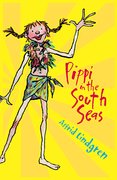
Pippi in the South Seas Adding to the fun of the Pippi books is the way she plays with language, inventing and mispronouncing words and names, singing nonsense songs, telling jokes and making up riddles. Obviously, this sets her translators a particularly tricky challenge! In the US Pippi Longstocking was translated in 1950 by Florence Lamborn, while it was translated in the UK by Edna Hurup in 1954 and published by Oxford University Press. Meanwhile, Pippi Goes Aboard (1956) and Pippi in the South Seas (1957) were translated by Marianne Turner. For a detailed comparison of these US and UK versions, see here: Pippi Goes Abroad by Madelene Moats.

Somehow, Pippi Longstocking completely passed me by as a child. Not only did I never read them, I'd never even heard of the books until they began to crop up regularly in discussions of children's literature in translation. So, coming to write about Astrid Lindgren now, I had some catching up to do...

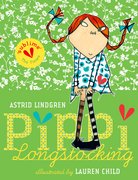
Pippi Longsticking, illustrated by Lauren ChildI read the newest translation by Tiina Nunnally (also OUP), published in 2007 and illustrated by Lauren Child of Charlie and Lola fame. Nunnally's translation is described as "sparkling" by the publishers and it certainly reads well. Combined with Child's illustrations it brings a modern air to the book - there are a lot of typographical quirks strongly reminiscent of the Charlie and Lola books. Judging by the examples in the essay I linked to above, it seems closer to the Lamborn translation than the Hurup - perhaps unsurprisingly as Nunnally is also American. She has a deft touch with the word play too - just to use one of the examples quoted by Moats, Pippi makes up a little rhyming ditty as she cooks pancakes for her friends.

The Swedish text is as follows (the normal word for pancake is pannkaka so an extra syllable has crept in there too):
Nu ska här bakas pannekakas,
nu ska här vankas pannekankas,
nu ska här stekas pannekekas. (1945:14)
Pippi Longstocking, Puffin Classics version
Hurup's version completely ignores the rhyme and the nonsense:

Here pancakes will be baked now,
here pancakes will be served now,
here pancakes will be fried now! (1954: 9)
Lamborn has:

Now we’re going to make a pancake, 
now there’s going to be a pankee, 
now we’re going to fry a pankye. (1977: 20)
We can now bring the comparison up to date by adding Nunnally's version:
Now it's time to make pancakes,
now it's time to flip panclips, 
now it's time to shape panchapes! (2007: 20)
To me, the last of these is the punchiest - Lamborn's is OK but doesn't scan so well.

From the reviews on Amazon it seems as though this version is succeeding in bringing in new readers attracted by the familiar style of the illustrations, which can only be a good thing. The physical book is also lovely and well produced. My only gripe is that the author and illustrator each get half-page biographies at the back of the book as well as name checks on the back cover and flaps. The translator, who has surely done as much as, if not more than, Lauren Child to make this book work just gets her name on the title page and the aforementioned "sparkling" in the blurb.


Friday, 23 March 2012

Domestication vs Foreignisation via Red Rage

This post was originally published on Lisa Carter's Intralingo blog a month ago: http://intralingo.com/domestication-vs-foreignisation-via-red-rage/

-------------------
One of the eternal debates in translation studies is whether to favour the domesticating or the foreignising approach, and one of the most famous quotations on the subject comes from Friedrich Schleiermacher’s On The Different Methods of Translating of 1815:
  “Either the translator leaves the writer in peace as much as possible and moves the reader toward him; or he leaves the reader in peace as much as possible and moves the writer toward him.”
(For a more detailed look at the article as a whole, check out this excellent post by Susan Bernofsky at Translationista, which I discovered while making certain I’d remembered the wording correctly: http://translationista.blogspot.com/2011/02/friedrich-schleiermacher.html )

On only my second ever book translation, I got the chance to see a practical application of each approach. Allen & Unwin in Australia and Annick Press in Canada had jointly bought the rights to Rote Zorn by Brigitte Blobel and I was approached to translate it. Relatively early on, I enquired whether to use the metric or imperial systems for weights and measures, given the differing approaches of the varying readerships to metrication. Leave them as they are, I was told. We’ll sort that out later.

But that was only the start. In the end, the two editions of the translation came to exemplify the foreignisation/domestication debate. Red Rage is the story of Mara, a sixteen-year-old girl, her dysfunctional family and the problems caused by her uncontrollable anger. The Canadian publisher decided to leave the reader in peace and move the story to a generic city high school somewhere in North America. The Australian publisher decided to leave the writer in peace and keep Mara in her post-war estate* in Essen.

Now this is where things start to get interesting. If we move the writer towards a North American reader, as well as using miles, we have to change most of the characters’ names. Mara stays the same, but her parents Günther and Beate become Gary and Beth, for example. The nationalities of the immigrant neighbours change. Suddenly sixteen-year-olds can no longer (legally) drink beer or ride a moped.

It is certainly true that anger, fear, dysfunctional families and rough estates* can be found anywhere. Perhaps it is easier for a North American teen to identify with a character if they don’t have to worry about cultural differences. All the same, I regret the loss of Mara’s father’s back story. His one great achievement had been to escape to the West from East Germany; after that, though, he’d never amounted to anything, and this goes a long way to explaining the way he acts now. Obviously, once the translation is no longer set in Germany, this section has to go. It’s only a couple of paragraphs, doesn’t affect the main plot. But it does add something. The author put it in for a reason…

I’ve gained more experience since then. Perhaps if the situation were to arise again I’d argue the case for leaving the writer in peace. It depends though. The balance between the writer and the reader shifts from book to book. I recently translated a series of detective novels set in London. As a result, I aimed to make them as smooth as possible. To use the imperial system, to make the dialogue sound British so as to avoid jarring the reader. But maybe it would have been interesting to see ourselves as the Germans see us?

No, there isn’t a simple answer, but I’d be interested in what anyone else thinks about it!
---------

* UK housing estate = US housing project. Thanks to Amalia Gladhart for making me aware of that little Pond difference.