 |
| German stamp from 2007 showing Astrid Lindgren and Emil |
Astrid Lindgren is apparently the 18th most translated author in the world. Also famous as an active campaigner for children's and animal rights, she wrote over 50 stories including the Emil, Karlson-on-the-Roof, Bill Bergson (Kalle Blomkvist in Swedish) and Bullerby children series. But she's best known for Pippi Longstocking, the strongest nine-year-old girl in the world.
Pippi lives alone (apart from a horse, and a monkey named Mr Nilsson) because her mother died when she was a baby and her father is lost at sea. She is fiercely self-sufficient but becomes good friends with the children next door, Tommi and Annika. Her lack of manners and education have made her contraversial with adults but incredibly popular with children ever since the first publication in 1945. It was felt (and still is, in some quarters) that she encourages rudeness and disrespect. Yet many more people claim Pippi as a role model: a feisty, free-spirited figure showing that there's nothing girls can't do.
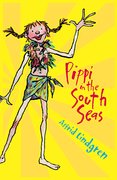 Adding to the fun of the Pippi books is the way she plays with language, inventing and mispronouncing words and names, singing nonsense songs, telling jokes and making up riddles. Obviously, this sets her translators a particularly tricky challenge! In the US Pippi Longstocking was translated in 1950 by Florence Lamborn, while it was translated in the UK by Edna Hurup in 1954 and published by Oxford University Press. Meanwhile, Pippi Goes Aboard (1956) and Pippi in the South Seas (1957) were translated by Marianne Turner. For a detailed comparison of these US and UK versions, see here: Pippi Goes Abroad by Madelene Moats.
Somehow, Pippi Longstocking completely passed me by as a child. Not only did I never read them, I'd never even heard of the books until they began to crop up regularly in discussions of children's literature in translation. So, coming to write about Astrid Lindgren now, I had some catching up to do...
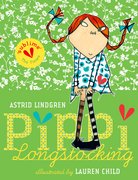 I read the newest translation by Tiina Nunnally (also OUP), published in 2007 and illustrated by Lauren Child of Charlie and Lola fame. Nunnally's translation is described as "sparkling" by the publishers and it certainly reads well. Combined with Child's illustrations it brings a modern air to the book - there are a lot of typographical quirks strongly reminiscent of the Charlie and Lola books. Judging by the examples in the essay I linked to above, it seems closer to the Lamborn translation than the Hurup - perhaps unsurprisingly as Nunnally is also American. She has a deft touch with the word play too - just to use one of the examples quoted by Moats, Pippi makes up a little rhyming ditty as she cooks pancakes for her friends.
The Swedish text is as follows (the normal word for pancake is pannkaka so an extra syllable has crept in there too):
Nu ska här bakas pannekakas,
nu ska här vankas pannekankas,
nu ska här stekas pannekekas. (1945:14)

Here pancakes will be baked now,Lamborn has:
here pancakes will be served now,
here pancakes will be fried now! (1954: 9)
Now we’re going to make a pancake,We can now bring the comparison up to date by adding Nunnally's version:
now there’s going to be a pankee,
now we’re going to fry a pankye. (1977: 20)
Now it's time to make pancakes,To me, the last of these is the punchiest - Lamborn's is OK but doesn't scan so well.
now it's time to flip panclips,
now it's time to shape panchapes! (2007: 20)
From the reviews on Amazon it seems as though this version is succeeding in bringing in new readers attracted by the familiar style of the illustrations, which can only be a good thing. The physical book is also lovely and well produced. My only gripe is that the author and illustrator each get half-page biographies at the back of the book as well as name checks on the back cover and flaps. The translator, who has surely done as much as, if not more than, Lauren Child to make this book work just gets her name on the title page and the aforementioned "sparkling" in the blurb.


