Showing posts with label adventure stories. Show all posts

Sunday, 20 May 2012

S is for (Andreas) Steinhöfel...

... a multi-award winning German author and translator. His books Dirk und Ich (My Brother and I) and The Centre of My World have also been translated into English, but the most widely available is The Pasta Detectives, published in 2010 by The Chicken House and translated from the German by Chantal Wright, one of my MA colleagues. It also features new illustrations by Steve Wells. The US edition (2011) is published under the title The Spaghetti Detectives and seems not to be illustrated.

The Pasta Detectives, pub. The Chicken House, 2010The Spaghetti Detectives, US edition, Chicken House, 2011


It's the story of Rico, aged 11 and a "child proddity"
-  "That's a bit like being a child prodigy, but also like the opposite. I think an awful lot, but I need a lot of time to figure things out." - 
who lives in Berlin with his mum. He has trouble telling the difference between left and right, and gets all kinds of things mixed up, yet he also notices a lot that other people don't see. He becomes friends with Oscar, who is a child prodigy but also prone to anxiety. Together they manage to solve the mystery of what exactly is going on in Rico's building, the "Aldi Kidnapper" or "Mr 2000", and the significance of the "deeper shadows".

This is another book with lots of wordplay as Rico often misunderstands what he hears. He also has difficulty with spelling, so when his teacher encourages him to write a diary the results are interesting, to say the least. As well as managing these challenges adroitly, the translation really catches Rico's voice and his view of the world - his head swirls with ideas like the balls bouncing around in a lottery machine. Some of Rico's ideas are very funny, while others are genuinely thought-provoking. You can see why it was shortlisted for the 2011 Marsh Award for Children's Literature in Translation. The book also won the 2011 NASEN Inclusive Children's Book Award and, with a first person narrator who seems to be somewhere on the austistic spectrum, it has invited comparisons with Mark Haddon's Curious Incident of the Dog in the Night Time.

There are two more books featuring Rico and Oscar, so let's hope that they will soon also be available in translation so that English-speaking readers can find out what happens next.

Friday, 18 May 2012

Q is for Québec

A guest post by Katy Manck as part of the WordCount Blogathon 2012:

When we first meet Sam in his small Québec hometown in The Book of Time, he’s sure that the junior high bully is going to beat him up. By the end of this compelling young adult trilogy, Sam has become stronger in many ways – as a friend to his cousin Lucy, as a quick thinker and problem solver, as a person who can resist the temptations of easy illegal riches, and as a young man who knows that the perils of going into high school are nothing compared to what he’s faced during his time travels.

Series author Guillaume Prévost is a history professor in France and has also written novels for adults – all in French. In a 2007 interview, he stated how much he enjoyed having William Rodarmor translate all three books in The Book of Time series, as Rodarmor frequently consulted him to clarify historical points and plot nuances. When his adult novels were translated, Prévost had very little involvement with the process.

As a reader, I feel that having the same translator for the entire series kept the narrative flow clear and the characters’ voices distinct as we hurtled back and forth through Time together. For more details (but no plot spoilers) about the books, please click on each title below to open my recommendation in a new window/tab:

The Book of Time (#1) introduces Sam, his recently bereaved father, and their shared gift of traveling through time using the sunstone and special coins.

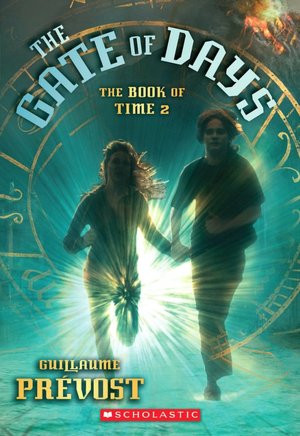
The Gate of Days (#2) takes Sam and his cousin Lucy to the castle of Vlad Tepes, Chicago’s gangster days, and rumbling Vesuvius as they search for Sam’s dad.

The Circle of Gold (#3) that enables time-travel from any location is what the Archos man seeks, so he holds Sam’s girlfriend hostage in Renaissance Rome until it is found.


Will Sam, his dad, Lucy, and Alicia all get back to Québec safe and sound?
Will the mysterious Archos man be defeated?

Katy ManckYou’ll have to read The Book of Time series to find out!

Check your local library, bookstore, or the publisher:
USA: Arthur A. Levine Books – all 3 books in hardcover
UK: Scholastic Books – first 2 books in paperback
Canada: Scholastic Books – book 1 in paperback

**Katy Manck, MLS
http://BooksYALove.blogspot.com
follow me on Twitter: @BooksYALove


About the author: Katy Manck is a retired academic/corporate/school librarian who finds joy in recommending young adult books beyond the bestsellers on her BooksYALove blog. She is treasurer of the International Association of School Librarianship and publicity chair for IASL’s free online international GiggleIT Project for student writers.

Tuesday, 15 May 2012

N is for 'The Neverending Story'

The Neverending Story by Michael Ende was first published in Germany in 1979 and translated into English by Ralph Manheim in 1983. It is possibly better known for the film  released in 1984 - I certainly came to read the book in my teens precisely because I'd enjoyed the film as a child - and yet the film only covers the first half of the book. Apparently, Michael Ende felt that it was so different from what he wrote that he sued the production company when they wouldn't stop production or change its name. He lost.

The Neverending Story, US editionThe Neverending Story, Michael Ende, Puffin UK edition

It is the story of Bastian Balthazar Bux, a boy who runs into a bookshop to escape from bullies. There he discovers a book called 'The Neverending Story' in which the land of Fantastica is under threat from the Nothing, the Childlike Empress is sick and a boy warrior named Atreyu is attempting to find a cure for her illness. As Bastian reads of Atreyu's adventures with Falkor the luckdragon, giants, werewolves and racing snails, he becomes literally drawn into and involved in the book. Eventually he realises that it is up to him to save this world. This is the point where the film finishes, yet Bastian goes on to have further adventures of his own in the world of Fantastica, until he realises that he is in danger of being trapped there forever.

As well as dealing with the importance and power of imagination, and the perils of getting what you wish for, it is about friendship, loyalty and identity. Imagination is not just restricted to the plot, either: each chapter begins with an ornamented initial capital - there are twenty-six of them in alphabetical order - while in some editions, although not the one I read, the text is colour-coded according to whether the action takes place in Fantastica or the real world.

Incidentally, if you'll pardon the digression,  David J. Peterson at dedalvs.com invites us to spare a thought for translators working into languages with other script systems. This led me to look into the Japanese translation. I didn't discover how that particular difficulty was overcome, but I learnt that Ende himself was fascinated with Japan and had a huge following there. His second wife was Mariko Sato who translated some of his books into Japanese.

Manheim's translation, meanwhile, deftly follows the German in alternating between a slightly old-fashioned, fairytale manner for the Fantastican parts and a more down-to-earth style. He also clearly had a lot of fun with the names! There were a few minor issues that struck me as odd - in some places the English seemed more extravagant than the German, while on other occasions it was the other way round. All the same, it's well written in either language, and an engrossing read. And if anybody has read it in a non-Latin script, I'd be fascinated to hear how it works!

Sunday, 13 May 2012

L is for Lindgren

German stamp from 2007 showing Astrid Lindgren and Emil


Astrid Lindgren is apparently the 18th most translated author in the world.  Also famous as an active campaigner for children's and animal rights, she wrote over 50 stories including the Emil, Karlson-on-the-Roof, Bill Bergson (Kalle Blomkvist in Swedish) and Bullerby children series. But she's best known for Pippi Longstocking, the strongest nine-year-old girl in the world.

Pippi lives alone (apart from a horse, and a monkey named Mr Nilsson) because her mother died when she was a baby and her father is lost at sea. She is fiercely self-sufficient but becomes good friends with the children next door, Tommi and Annika. Her lack of manners and education have made her contraversial with adults but incredibly popular with children ever since the first publication in 1945. It was  felt (and still is, in some quarters) that she encourages rudeness and disrespect. Yet many more people claim Pippi as a role model: a feisty, free-spirited figure showing that there's nothing girls can't do.

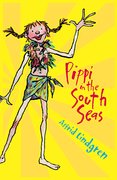
Pippi in the South Seas Adding to the fun of the Pippi books is the way she plays with language, inventing and mispronouncing words and names, singing nonsense songs, telling jokes and making up riddles. Obviously, this sets her translators a particularly tricky challenge! In the US Pippi Longstocking was translated in 1950 by Florence Lamborn, while it was translated in the UK by Edna Hurup in 1954 and published by Oxford University Press. Meanwhile, Pippi Goes Aboard (1956) and Pippi in the South Seas (1957) were translated by Marianne Turner. For a detailed comparison of these US and UK versions, see here: Pippi Goes Abroad by Madelene Moats.

Somehow, Pippi Longstocking completely passed me by as a child. Not only did I never read them, I'd never even heard of the books until they began to crop up regularly in discussions of children's literature in translation. So, coming to write about Astrid Lindgren now, I had some catching up to do...

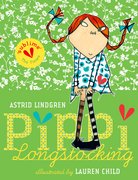
Pippi Longsticking, illustrated by Lauren ChildI read the newest translation by Tiina Nunnally (also OUP), published in 2007 and illustrated by Lauren Child of Charlie and Lola fame. Nunnally's translation is described as "sparkling" by the publishers and it certainly reads well. Combined with Child's illustrations it brings a modern air to the book - there are a lot of typographical quirks strongly reminiscent of the Charlie and Lola books. Judging by the examples in the essay I linked to above, it seems closer to the Lamborn translation than the Hurup - perhaps unsurprisingly as Nunnally is also American. She has a deft touch with the word play too - just to use one of the examples quoted by Moats, Pippi makes up a little rhyming ditty as she cooks pancakes for her friends.

The Swedish text is as follows (the normal word for pancake is pannkaka so an extra syllable has crept in there too):
Nu ska här bakas pannekakas,
nu ska här vankas pannekankas,
nu ska här stekas pannekekas. (1945:14)
Pippi Longstocking, Puffin Classics version
Hurup's version completely ignores the rhyme and the nonsense:

Here pancakes will be baked now,
here pancakes will be served now,
here pancakes will be fried now! (1954: 9)
Lamborn has:

Now we’re going to make a pancake
now there’s going to be a pankee
now we’re going to fry a pankye. (1977: 20)
We can now bring the comparison up to date by adding Nunnally's version:
Now it's time to make pancakes,
now it's time to flip panclips
now it's time to shape panchapes! (2007: 20)
To me, the last of these is the punchiest - Lamborn's is OK but doesn't scan so well.

From the reviews on Amazon it seems as though this version is succeeding in bringing in new readers attracted by the familiar style of the illustrations, which can only be a good thing. The physical book is also lovely and well produced. My only gripe is that the author and illustrator each get half-page biographies at the back of the book as well as name checks on the back cover and flaps. The translator, who has surely done as much as, if not more than, Lauren Child to make this book work just gets her name on the title page and the aforementioned "sparkling" in the blurb.


Wednesday, 9 May 2012

H is for Hergé

Confession time - I was always a very partisan child so, being devoted to Asterix, I never read Tintin. So for today, here's a guest post by my husband and proofreader-in-chief:


The cast of the Adventures of Tintin
The cast of The Adventures of Tintin


H is for Hergé, but really, there’s only one thing anyone thinks of when they hear his name – Tintin.

What’s so great about Tintin? To be honest, that’s a question I’ve asked myself before, since discovering him aged 10 or 11. I loved the books back then, devouring them avidly, and I still have a huge amount of affection for them, but reading Tintin as an adult, it’s hard to pin down exactly where the appeal lies.

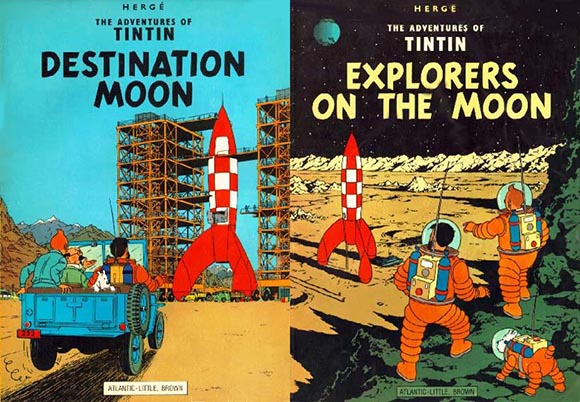
The books are certainly of their time – leaving aside some slightly dubious racial attitudes (even apart from the notorious Tintin in the Congo), the modern reader may be surprised to see just how much smoking and heavy drinking there is, something I can’t imagine in more modern books. And in the moon landing stories (Destination Moon, Explorers on the Moon) there’s a jarring reminder that they were written several years before the first launch of the Sputnik Programme, and are closer to Jules Verne and H.G. Wells than modern science fiction.
Tintin - Destination Moon and Explorers on the Moon

The characters are drawn with very broad brushes, becoming archetypes if you’re generous, stereotypes if you’re not – the brave young hero, the salty sea-dog and the brilliant but absent-minded professor are all present and correct, while the villains tend to scowl a lot, smoke cigars and regularly use chloroform to abduct people. Maybe this simple characterisation, along with the slightly “boys’ own” style, is what makes it so accessible across cultures.

While not being packed with puns in the manner of Asterix, for example, the English translations of Tintin still attempt to replicate the humour and wordplay in the originals. Dialogue gets tweaked to make convincing jokes based on Professor Calculus mishearing things, and in Tintin and the Picaros the translators, Leslie Lonsdale-Cooper and Michael Turner, take full advantage of Hergé’s invented language. The speech of the Arumbaya Indians looks foreign, but resembles appropriate English phrases when spoken aloud (e.g. “Oozfah sek 'unds” meaning “who’s for seconds?”), and their name for the pyramid, Hotwattabottl, hopefully needs no further explanation.

It’s easy to be negative about Tintin, especially in light of recent rows about racism, but the books have an enduring appeal. These ripping yarns are possibly a little dated, but they still wear the years well as an artefact of a more innocent time, when good guys wore white hats and bad guys wore black hats, smoking was a harmless pleasure, and the natural instinct of a villain was to lock you up somewhere until they’d carried out their evil scheme.

So I enjoy them for what they are - gripping adventures in a variety of settings with some truly iconic cartoon imagery, perfect escapist reading matter.

Monday, 7 May 2012

F is for Cornelia Funke

Cornelia Funke is a hugely successful, award-winning German author of fantasy and adventure books for children of all ages - they range from picture books to young adult novels. She started out as an illustrator before beginning to write herself and became very popular in Germany in the nineties before her books began to become known in English a decade or so later. She is probably best known for the Inkworld trilogy, the first book of which, Inkheart, was also made into a 2008 film with what you might call an all-star cast.

The Princess KnightI was just about to write that Funke is an author I hadn't previously read, when I checked her publications list and realised that fils aîné had borrowed The Princess Knight (tr. Anthea Bell, Chicken House, 2003) from the library a while ago. It's the story of the entirely non-girly Princess Violetta who wants to be a knight like her brothers and is disgusted when her father holds a tournament with her hand in marriage as the prize. With ingenuity and determination, "Little Vi" manages to outwit them all and choose her own path in life. It's also beautifully illustrated by Kerstin Meyer and a welcome antedote to all the Disney princess stuff that makes me glad to have boys!


Anyway, although I was aware of the Inkworld trilogy, I hadn't read any of Funke's fantasy novels because they came along too late for my childhood and the boys are still too young for them. In the last couple of weeks, I've read Igraine the Brave (tr. Anthea Bell, Chicken House, 2008) and Dragon Rider (tr. Anthea Bell, Chicken House, 2005) and hope that they provide a fairly representative sample of her work - I couldn't get hold of Inkheart etc in time for this project.

Igraine the BraveIgraine is another little girl who wants to be a knight. The book is for younger children, 7+ according to the publishers, and I hope it's the sort of thing fils aîné might be getting round to before long.  Her parents are famous magicians who manage to accidentally transform themselves into pigs. This means that Igraine has to put things right, meeting dragons, giants and all kinds of adventures on the way. It would be a good introduction to chapter books, chivalry, knights in armour and so on because none of the dangers ever get beyond what the film industry calls "mild peril", and it's short at 224 pages. It is also wittily told by both Funke and Bell, and illustrated by the author.


Dragon RiderDragon Rider, also illustrated by Funke herself, is a more ambitious undertaking altogether. Weighing in at 560 pages, it's for the 10+ age group and tells the story of a dragon named Firedrake, a brownie named Sorrel and a boy named Ben. Together they set off on an epic journey to find the long-lost valley where the last dragons can live in peace, undisturbed by human greed. Of course there are plenty of dangers to be overcome here too, and an ancient enemy is on their trail... Reading as an adult, I quite enjoyed it but felt that it lacked depth. The characters seemed rather too obvious, the dangers rather easily overcome. And I do always feel a little irritated when the journey out takes 550 pages and the return leg can be summed up in a couple of lines! Probably despite the length and the 10+ label it might be suited to a younger audience still. I can imagine that in a few years' time, the boys will love it.